
CONSERVE HELIUM
An Essential Resource for All Generations
SCIENCE · HISTORY · STEWARDSHIP
What Helium Makes Possible
Helium serves humanity in many ways. Each application has its own technical requirements, consumption pattern and opportunities to reduce losses.
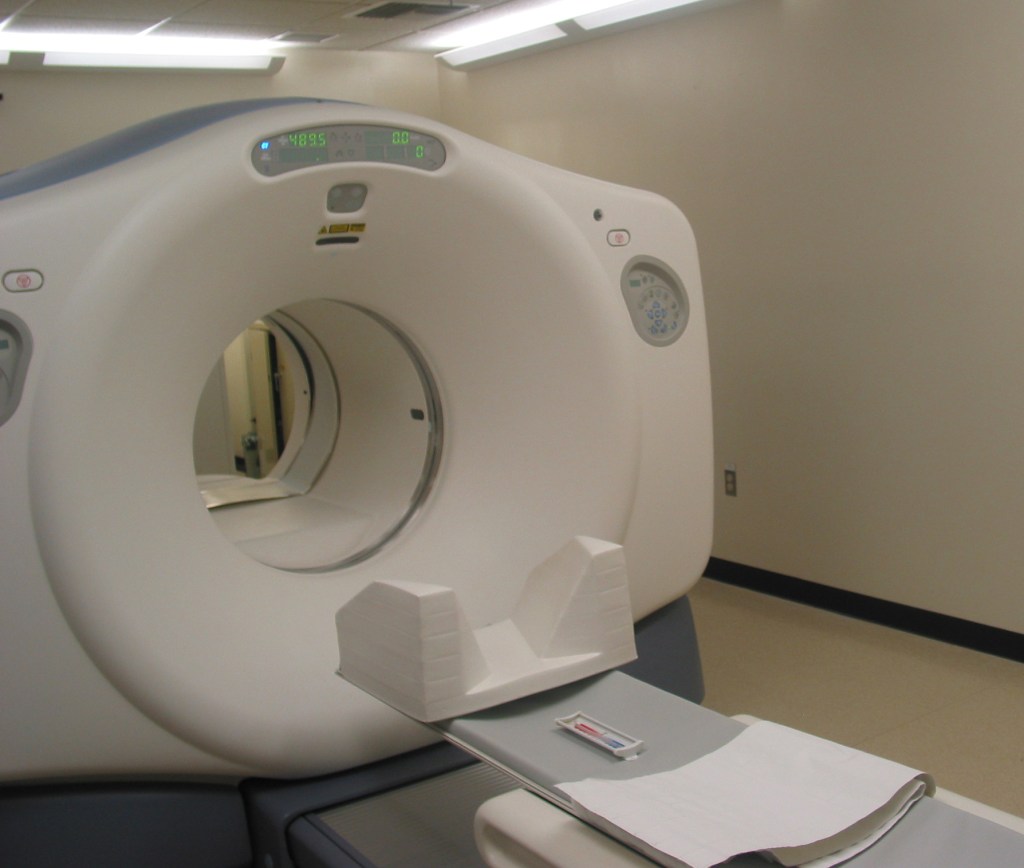
MRI scanner. General application image; no particular magnet specification is implied. NIH / NIBIB.
On this page · MRI and medical imaging · Particle physics and research · Semiconductors and industrial processes · Space systems and airships · Keeping Time, Keeping Helium · Deep diving · Three questions for every user
Explore the application guides
Finding the Invisible Leak · The Helium Behind Fiber-Optic Communications · The Laboratory’s Carrier Gas · Colder Than Liquid Helium: Quantum Research · Helium and Fusion Research · Balloons That Carry Science · Helium in Welding and Metal Fabrication
New research features: CERN: keeping helium in the loop · NMR spectroscopy and molecular structure.
MRI and medical imaging
Liquid helium cools superconducting magnets in many MRI systems. Technology is changing: Philips describes BlueSeal magnets with a sealed seven-liter helium inventory and no routine refills. That manufacturer claim refers to particular systems; “helium-free operations” does not mean no helium is present.
Procurement comparisons should consider the magnet’s inventory, expected losses, servicing requirements and recovery during retirement.
Sources: USGS [S02] · Philips [S45]
Particle physics and research
CERN’s helium cooling supports the superconducting systems of the Large Hadron Collider. The operating temperature and circulating inventory illustrate why recovery infrastructure belongs in the discussion of research equipment.
Sources: CERN [S17]
Semiconductors and industrial processes
USGS identifies semiconductor manufacturing among helium’s uses. The specific job matters: cooling, process conditions and leak testing are different functions. An assertion that all inert atmospheres depend on helium would obscure the roles of other gases.
A useful conservation review starts with the actual process, required purity and whether a technically suitable substitute or recovery loop exists.
Sources: USGS [S02]
Space systems and airships
NASA describes helium being used to purge hydrogen systems and pressurize ground and flight fluid systems. These functions help explain why a gas can be valuable without becoming part of a finished product.
Sources: NASA [S18]
Helium for airship lift
Airships use gaseous helium for buoyancy. Explore their history, today’s sightseeing and broadcasting fleets, and the larger cargo aircraft still in development. The guide also asks how operators can measure losses and recover their lifting gas.
Keeping Time, Keeping Helium
Boulder’s precision-time research offers a concrete example of helium’s service to science. A 2008 paper by NIST researchers describes a mercury-ion optical clock with an ion trap near 4.2 kelvin (−269°C) and a coil immersed in a liquid-helium bath. The cold environment helped maintain an exceptionally clean vacuum, reducing collisions with background gases and allowing an ion to remain trapped for months. Lasers separately cooled and measured the ion.
Clock apparatus: NIST researchers, section 2.1, printed pages 20–21 [S56].
The cooling method depends on the clock. NIST-F2, a cesium fountain, used liquid nitrogen to cool its microwave cavity and flight region to about 80 kelvin. Its cesium atoms were cooled with lasers. These are distinct roles for cryogenic cooling and laser cooling.
Clock comparison: NIST-F2 accuracy evaluation [S58] · How NIST-F2 works [S06].
From boil-off to another use
As liquid helium absorbs heat, it becomes gas. That phase change does not use up the helium. A recovery system can capture the boil-off, purify it and return it to a liquefier. Refrigeration supplies the energy needed to make it liquid again.
- Capture: collect the gas leaving the experimental equipment.
- Recover and purify: retain the helium and remove impurities before liquefaction.
- Liquefy: cool the recovered gas back into liquid helium.
- Reuse: return the liquid to research equipment and repeat the cycle.
Recovery principles: Ray Radebaugh / NIST, section F1.3.1.3 [S59]. This is a general process description, not a diagram of a particular Boulder installation.
Boulder’s conservation infrastructure
In May 2009, NIST announced $7.5 million for construction of liquid-helium recovery systems at its Boulder and Gaithersburg campuses combined. A later NIST Boulder superconducting-electronics paper confirms that its laboratory had a helium recovery and liquefier system supporting experiments in 100-liter liquid-helium dewars.
CU Boulder documents a separate Physics Department facility that captures helium used by Physics, JILA and LASP and returns it for liquefaction. Its 2022 sustainability award described the facility as having been established about a decade earlier. CU’s 2023 account confirms that recovery reduces helium losses and research costs.
Institutional evidence: NIST funding announcement [S57] · NIST Boulder electronics research, section IV [S62] · CU Green Labs Awards 2022, page 1 [S60] · CU Boulder recovery account [S61].
The equipment behind the recovery loop
NIST’s February 2024 maintenance statement describes a Boulder facility supplying 15,000–20,000 liters of liquid helium per year. Its equipment included a 4,000-cubic-foot helium-gas collection bag, a Bauer recovery compressor, a Linde RS compressor, a Linde 500A purifier and a Linde 1410 liquefier. NIST states that the system was purchased as part of construction of Boulder’s Precision Measurement Laboratory.
An August 2022 NIST notice identifies a research instrument supplied by this recovery system: a 14.1-tesla NMR magnet. It says that all the magnet’s liquid helium had come from the Boulder system for several years. It also describes supply restrictions making it difficult to replace helium lost from the recovery system. Recycling reduced dependence on new supplies, but did not eliminate that dependence.
Historical operating evidence: NIST maintenance statement, attached PDF section I [S63] · NIST helium fill notice [S64]. Annual output is not a measured recovery percentage. The NMR instrument is separate from the clock.
What remains to document: the NIST Boulder plant’s commissioning date, measured recovery rate and the return-line connection from the mercury-ion clock. These sources establish the clock’s helium use and local recovery facilities, but do not establish a particular supplier’s connection to the clock.
The conservation lesson is practical: plan for helium’s return when planning for its use. Explore helium conservation.
Deep diving and breathing gases
Helium helps reduce breathing-gas density and nitrogen narcosis in specialized diving. Explore heliox and trimix, saturation diving, and the systems that can recover gas from divers, chambers and bells.
Three questions for every user
What quantity does this system hold? What quantity does it lose during normal operation and servicing? What can be recovered or avoided without compromising the task?
These questions make conservation measurable across very different applications.
Sources: APS / ACS / MRS [S27]

