CONSERVE HELIUM
An Essential Resource for All Generations
SCIENCE · HISTORY · STEWARDSHIP
The Science of Helium
Element 2 is both familiar and extraordinary. Its useful properties become easier to understand when we follow it from geological formations to a working laboratory.
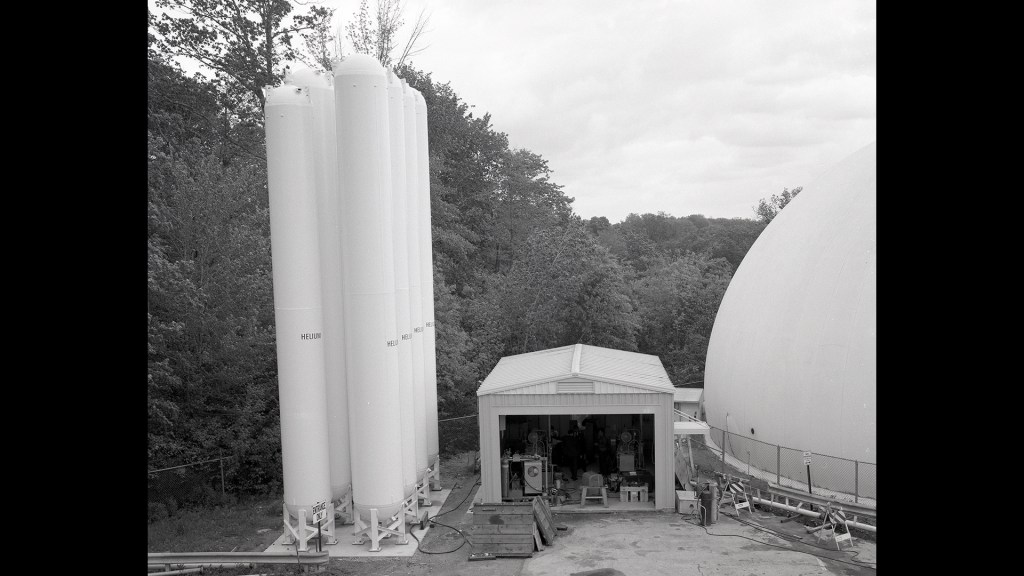
Helium storage at NASA’s Rocket Engine Test Facility. Historical photograph. NASA Glenn Research Center.
On this page · A useful combination of properties · A geological resource, a manufactured supply · Cold enough for demanding physics · Follow the material · Why recovery matters
Explore helium science and supply
Where Helium Comes From—and Where It Goes · Helium-3 and Helium-4 · Superfluid Helium: Matter Behaving Strangely
Reference desk: Helium glossary and units · Complete topic index.
A useful combination of properties
Helium is a noble gas with atomic number 2. Its chemical inertness, low density and exceptionally low boiling temperature support very different uses. The pressure and physical state matter when comparing temperature data; a laboratory’s liquid-helium system is different from a cylinder of room-temperature gas.
Sources: Royal Society of Chemistry [S01] · NIST [S13]
A geological resource, a manufactured supply
Commercial supplies depend on finding helium-bearing gas, separating the helium, purifying it and delivering it in a usable form. A resource estimate describes helium in the ground under stated assumptions. It does not measure how much a hospital can order tomorrow.
Extraction, processing capacity, storage and transport each affect availability. New discoveries can expand the supply outlook while customers still face an immediate shortage.
Sources: USGS [S14] · USGS [S02]
Cold enough for demanding physics
CERN describes the Large Hadron Collider’s helium cooling system operating at 1.9 kelvin. Its helium circulates in a closed system. The quantity held in that system should not be confused with annual consumption or annual losses.
This is a useful model for discussing conservation: distinguish the inventory needed to operate equipment from the fresh helium needed to replace what escapes.
Sources: CERN [S17]
Follow the material
Ask four questions of any application: How much enters? How much remains in equipment? How much is recovered? How much leaves the system?
Helium-3 and helium-4 also need separate treatment. A project evaluating the rarer isotope is not automatically a new source for the bulk helium market.
Sources: USGS [S02]
Why recovery matters
Geological availability does not make helium unlimited on human timescales. Conservation begins with preventing avoidable losses and improving recovery where it is practical. Those choices connect the science to procurement, engineering and public policy.
Sources: USGS [S14] · APS / ACS / MRS [S27]

