
CONSERVE HELIUM
An Essential Resource for All Generations
SCIENCE · HISTORY · STEWARDSHIP
From the Sun to the Laboratory
Helium’s history links astronomy, natural gas, low-temperature physics and decisions about stewardship.
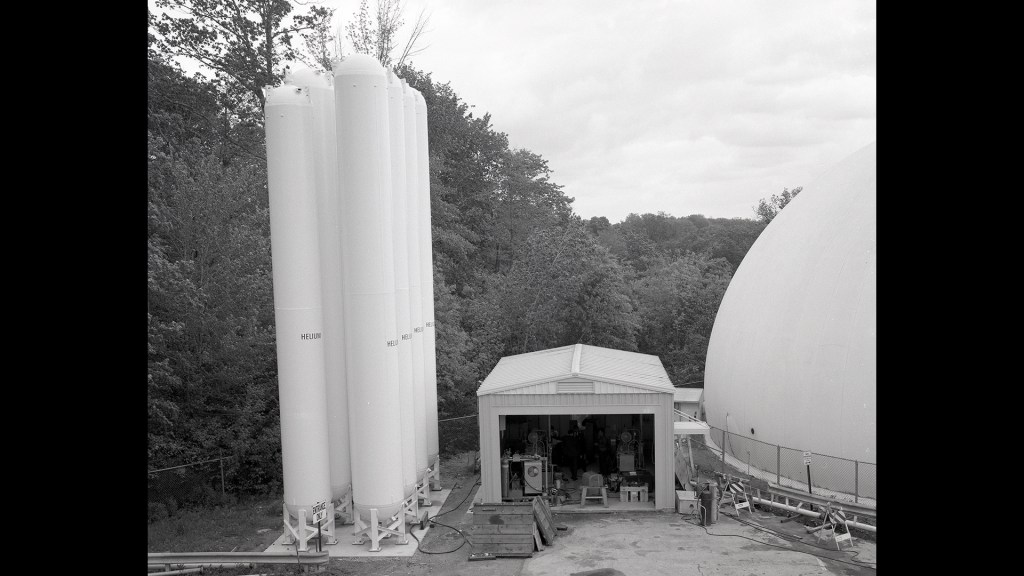
Helium storage at NASA’s Rocket Engine Test Facility. Historical photograph. NASA Glenn Research Center.
On this page · 1868–1895: a new element · 1905: helium in natural gas · 1908: reaching the liquid state · From conservation to disposal · The next chapter
1868–1895: a new element
Helium’s story began with a spectral observation in sunlight in 1868, before its identification on Earth in 1895. Its name preserves that solar origin.
Sources: Royal Society of Chemistry [S01]
1905: helium in natural gas
The American Chemical Society recounts how Hamilton Cady and David McFarland identified helium in gas from Dexter, Kansas. Their work helped establish natural gas as a practical terrestrial source.
Sources: American Chemical Society [S15]
1908: reaching the liquid state
Heike Kamerlingh Onnes liquefied helium in 1908. His Nobel lecture records the low-temperature investigations that opened new experimental possibilities. The historical account belongs alongside modern reference data when discussing numerical properties.
Sources: Heike Kamerlingh Onnes / Nobel Foundation [S16] · NIST [S13]
From conservation to disposal
Federal policy later supported helium conservation and a storage system. The 1996 Helium Privatization Act established a disposal framework; the 2013 Helium Stewardship Act revised that framework. The Bureau of Land Management announced completion of the system’s sale to Messer in June 2024.
The laws, their scheduled deadlines and the actual transfer are separate milestones. The federal reserve timeline follows those distinctions.
Sources: BLM [S03] · U.S. Congress / GovInfo [S19] · U.S. Congress / GovInfo [S20] · BLM [S04]
The next chapter
Conserve Helium’s position is that this history should lead to more deliberate stewardship: recover usable gas, measure losses and preserve options for future users. The history pages provide context for that advocacy; they do not attribute every supply disruption to one policy decision.

