
CONSERVE HELIUM
An Essential Resource for All Generations
SCIENCE · HISTORY · STEWARDSHIP
The Federal Helium Reserve
The reserve story deserves a precise timeline. A statutory deadline, the sale of infrastructure and the quantity of helium remaining are different facts.
On this page · 1960: a conservation program · 1996: the privatization framework · 2010: a scientific review · 2013: stewardship and disposition · June 2024: the completed sale · 2026: read the inventory categories · Questions for stewardship
1960: a conservation program
BLM’s historical account describes the 1960 conservation program and the acquisition and storage of helium. This established the setting for later arguments about federal needs, debt, pricing and disposal.
Sources: BLM [S03]
1996: the privatization framework
The Helium Privatization Act of 1996 changed the federal program and established a framework for disposing of crude helium. The enacted text is the starting point for understanding the policy; later outcomes require their own evidence.
Sources: U.S. Congress / GovInfo [S19]
2010: a scientific review
The National Research Council’s Selling the Nation’s Helium Reserve examined the effects of the policy and offered recommendations. Its conclusions are a committee assessment, distinct from enacted law or a current operating report.
Sources: National Research Council [S25]
2013: stewardship and disposition
The Helium Stewardship Act of 2013 established a revised phased framework, including provisions for auctions and disposal. Its scheduled dates should not be reported as proof that a physical sale or closure happened on those dates.
Sources: U.S. Congress / GovInfo [S20]
June 2024: the completed sale
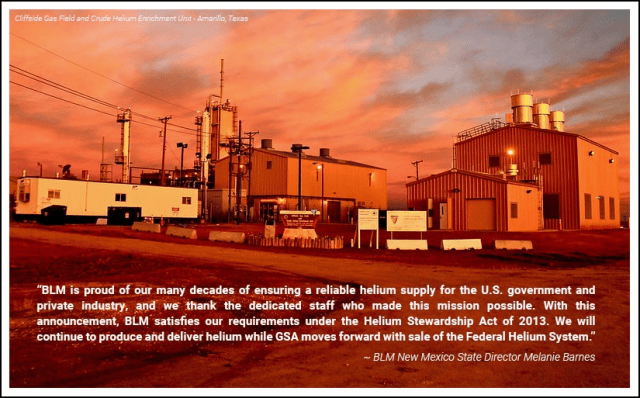
BLM’s 2023 Federal Helium System sale-announcement graphic. Historical statement. Bureau of Land Management.
BLM announced completion of the Federal Helium System sale to Messer on June 27, 2024. This documents a transition to private ownership. By itself, the announcement does not establish that all stored helium was exhausted or that every facility was abandoned.
Sources: BLM [S04]
2026: read the inventory categories
USGS’s 2026 summary lists no government stockpile while separately describing privately owned helium storage in Texas. “No government stockpile” is therefore different from “no stored helium.”
Underground resources, recoverable reserves, privately stored gas, pipeline inventory and annual output need separate measures. A conservation assessment should identify which one it is discussing.
Sources: USGS [S02] · USGS [S14]
Questions for stewardship
What storage capacity remains available? Who can access it? What losses occur during extraction and processing? What public needs justify long-term protection?
These are the questions this project will explore through statutes, oversight reports and operating records. The RMH case archive will be developed separately at the end of the public foundation work.

